





Moss Giants
The Söderlångvik Museum, Kemiönsaari
- 2.5.2025–
Four huge, bright green figures by Kim Simonsson have taken root in the forest on Örudden in Söderlångvik.
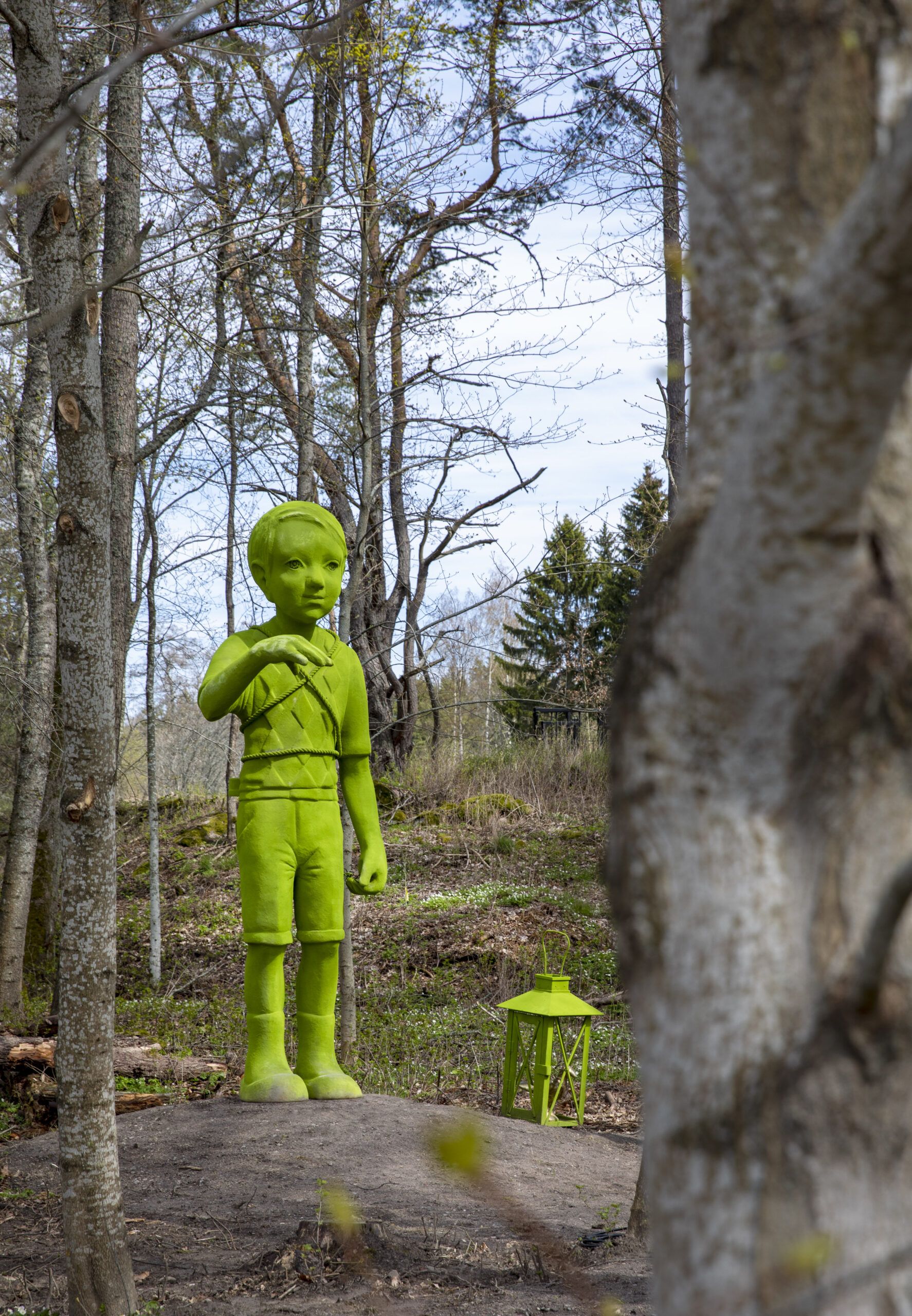
Four huge, bright green figures have taken root in the forest on Örudden here in Söderlångvik. This is their permanent home where they’re becoming a part of the surrounding nature –hopefully real moss begins to grow on the big sculptures. The moss giants give off an air of mystery. Their origin is unknown: are they visitors from a parallel reality, or have they always been part of this world as we know it?
“The moss children are independent, and don’t need the help of adults,” Simonsson says. The children form a community, a band of travellers. Each child has been given its own specific task, all equally significant for their coexistence. Some carry tools and transport equipment on their backs, others are accompanied by animals, hinting at a close relationship with the natural and non-human world. Sign language allows them to communicate silently with one another and with their surroundings. Their presence reflects the artworks’ underlying idea of a utopian world where humans, animals and other beings co-exist peacefully. Perhaps the moss giants could be understood as monuments of wonder, or guides to a more imaginative view of the world. Rather than proclaiming truths, they invite us to question, dream and imagine in the same fearless way that children do. “It is important to give space to ideas that at first glance seem absurd,” Simonsson explains.
The set of artworks is completed by the Song of the Moss Giants, a piece of music composed by Perttu Haapanen. During the summer months the giants open their lungs at sunrise, and also sing midday at noon, 3 p.m. and they end the day by singing at sunset. What do giant children’s songs sound like and what do they sing about?
BRINGER OF LIGHT
2022
Iron frame, polystyrene, fibreglass, nylon fibre, paint
(4,22 x 1,5 x 1,68 m)
Bringer of Light is a giant with a lantern by his side and a lamp on his back. The mass-produced desk light and the shorts and vest of the figure are strikingly ordinary compared to this otherwise fantastical being. The figure stretches out an open palm facing down, fingers spread wide. This is the sign for lamp and light, but also for the very moment when a light is switched on. Like children, light is often seen as a symbol of hope, pointing towards the possibility for a brighter future. Perhaps it’s also the task of the Light bringer to shine a light on things that feel difficult to deal with.
FRIENDSHIP
2022
Iron frame, polystyrene, fibreglass, nylon fibre, paint
(3,04 x 2,14 x 2,06 m)
This giant child is peacefully seated by the small pond in the forest. Like an attentive listener, the being leans gently forward with an enigmatic smile. A frog and a squirrel have found their way into the open palms of the giant sitting cross-legged. A first glance would suggest a harmonious co-existence between the three creatures, yet the nature of their relationship is unclear. The sculpture invites us to reflect on the conditions under which friendship can arise and between whom.
WANDERER
2022
Iron frame, polystyrene, fibreglass, nylon fibre, paint
(4,16 x 1,24 x 2,08 m)
A wanderer with skis and poles has landed in midst of the woods, perhaps ready to chart unknown territories. The giant hands declare a mission – two fingers moving across the palm is the sign for walking, or hiking. As sign language is largely based on movement, its expressive power is directly linked to the body and to touch. Humans gain an understanding of the world largely through our sense of touch. Another way to explore the world is through travel. But travelling doesn’t always entail moving from one far-flung place to another. It can also be an act of introspection, digging deep into our memories.
COLLECTOR
2022
Iron frame, polystyrene, fibreglass, nylon fibre, paint
(3,64 x 1,7 x 2 m)
The giant Collector observes surrounding nature with alert eyes, perhaps searching for something worth collecting. The giant’s hands give a gentle impression, as if they were cupped around an invisible object. This is the sign for collecting in Finnish sign langue. As part of his artistic process, the artist Kim Simonsson uses objects found in his studio to design the individual equipment for each giant. This intuitive way of working is evident in the Collector’s equipment, which consists of a mishmash of different utensils and organic natural elements. What is worth collecting and saving for the future, and who gets to decide that? In an everchanging world, the previously useless can suddenly become an absolute necessity.
The Moss Giants’ Songs
By composer Perttu Haapanen
From the very beginning, Kim Simonsson had the idea of gibbon sounds, and the morning, day and evening songs of the giants, which would occur according to the rhythm of nature and the sun. First, I made different demos, from which these hooting sounds were then selected. The fact that the Moss Giants remain motionless in the forest and gradually turn mossy steered the idea away from the human-like sounds and towards a more nature-inspired one.
The songs of the giants fall somewhere between hooting of gibbons, birds’ song and choral singing of humans. The modified sounds of the gibbons are also combined with formants of the human voice, i.e. amplifications of the frequency ranges typical for different vowels. The harmonies and rhythms of the songs are from the human world, but I have retained a small amount of living imprecision and chance in them. The inspiration is not only the spontaneous singing of children, but also the freedom of birds singing together. The childlike quality is also reflected in the fact that the sounds are not the size of giants. The large vocal tracts are reflected more in the slowed-down and stretched-out nature of the sounds.
The Moss Giants’ songs are quite gentle and all four have their own voices. Each has a role to play in the songs. The Bringer of Light has the lowest vocals and provides the others with a harmonious base and support. Friendship is the peaceful support and unifier. The Wanderer and the Gatherer are the leaders of the songs and have the highest voices. The Gatherer in particular is very active in the daytime song. The Morning Song is calm and “awakening”. The daytime song is more active and playful. The evening song is more soothing towards the night.
Perttu Haapanen (b. 1972) is a Finnish composer specialising in art music. He lives in Helsinki and has studied composition at the Sibelius Academy, as well as electroacoustic music at the Parisian IRCAM institute. He is particularly interested in how voice and language relate to music.
Share this with your friends!



Museum exhibitions
Museum events
Osana kulttuurikierrosta
Museum contact details

The Söderlångvik Museum
Amos Anderson tie 2, 25870 Dragsfjärd
(02) 424 662
Yhteydet julkisilla
Näytä reitti museolle Matkahuollon reittioppaassa

Katso reitti Matkahuollon reittioppaassa
Päämäärä:
The Söderlångvik Museum, Amos Anderson tie 2, 25870 Dragsfjärd
Lähtöpiste:
Admission fees

14/7/7/0 €
Payment methods
Yleisimmät pankki- ja luottokortit
De vanligaste bank - och kreditkorten
Opening hours
| Mon | 11:00-17:00 |
| Tue | 11:00-17:00 |
| Wed | 11:00-17:00 |
| Thu | 11:00-17:00 |
| Fri | 11:00-17:00 |
| Sat | 11:00-17:00 |
| Sun | 11:00-17:00 |
Open daily 1.5.2026-30.9.2026 and 14.11-16.12.2026. Closed 19.6.2026